Shot Sizes as Verbs: A Little Giveaway
A small giveaway you might find practical. A one-page reference for shot sizes, framed as verbs: not what each size is, but what it does, when to use it, and when to hold back. Pin it, screenshot it, or keep it open while you line a script.
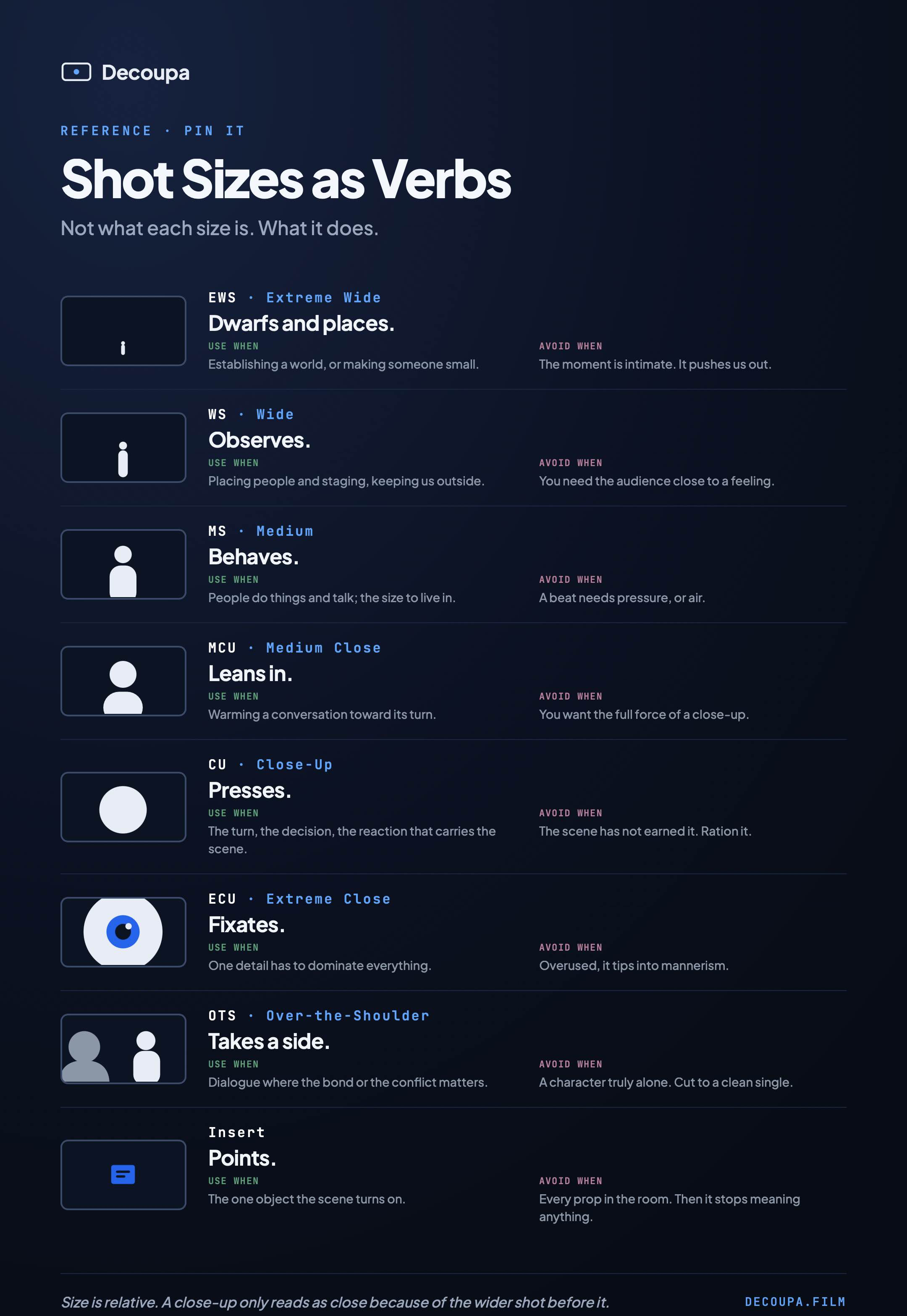
The idea is simple. A size is not a label you add once you already know what matters. It is one of the tools you use to decide what matters in the first place. So it helps to read each one as a verb.
The full list, in text:
| Size | Does | Use when | Avoid when |
|---|---|---|---|
| EWS, Extreme Wide | Dwarfs and places. | Establishing a world, or making someone small. | The moment is intimate. It pushes us out. |
| WS, Wide | Observes. | Placing people and staging, keeping us outside. | You need the audience close to a feeling. |
| MS, Medium | Behaves. | People do things and talk, the size to live in. | A beat needs pressure, or air. |
| MCU, Medium Close | Leans in. | Warming a conversation toward its turn. | You want the full force of a close-up. |
| CU, Close-Up | Presses. | The turn, the decision, the reaction that carries the scene. | The scene has not earned it. Ration it. |
| ECU, Extreme Close | Fixates. | One detail has to dominate everything. | Overused, it tips into mannerism. |
| OTS, Over-the-Shoulder | Takes a side. | Dialogue where the bond or the conflict matters. | A character is truly alone. Cut to a clean single. |
| Insert | Points. | The one object the scene turns on. | Every prop in the room. Then it stops meaning anything. |
One thing the chart leaves implicit, worth saying out loud: size is relative. A close-up only reads as close because of the wider shot before it. That is why the close-up is the easiest thing in the kit to spend carelessly, and why holding it back is a tool of its own.